Timing-controllable music generation

taan puts the momentin the music

Any model can make music that sounds good. For anything cut to picture, it also has to hit its mark on time. taan.ai is built timing-first, so an instructed event lands within a fraction of a second of where you asked. On the first benchmark of temporal controllability in text-to-music, taan places instructed events on time 2.8× as often as the best commercial system we tested.

Why timing

Every other model nails what. only taan nails when.

"Bring in the drums at the sixth second" only works if the drums arrive at the sixth second. Text-to-music systems produce polished audio in seconds, but they place events near the requested moment, not at it, which breaks the instant a composer cuts music to a scene. taan is engineered around that instant. We built the first benchmark that measures it, and taan tops it.

80.1%
of taan's instructions delivered on time, benchmark-wide
73.2%
of taan's timed events land within ±500 ms of the cue
0%
of instructed events taan omits; it renders every requested one
51
points ahead of the next-best system
The test

Did the instructed event happen, on time?

Each prompt asks for a specific musical event at a specific moment. The benchmark scores whether it lands within a tolerance of the requested timestamp, across three families of instruction, using the same detectors, gates, and tolerances for every system.

Type 1 · single timed event Type 2 · timed sequence Type 3 · global tempo Tolerance ladder · ±250 / 500 / 1000 / 2000 ms
Results · taan vs the field
taan leads on timing by a wide margin.

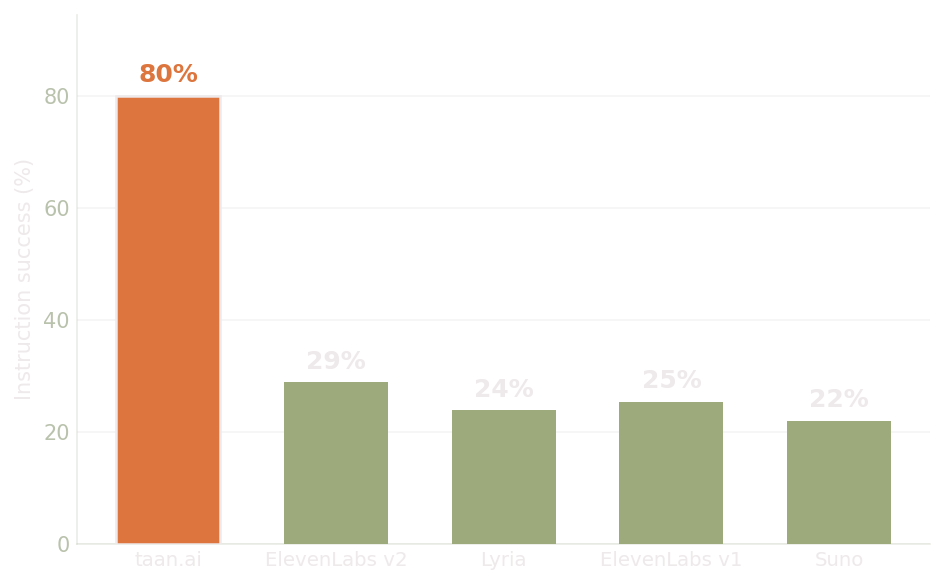
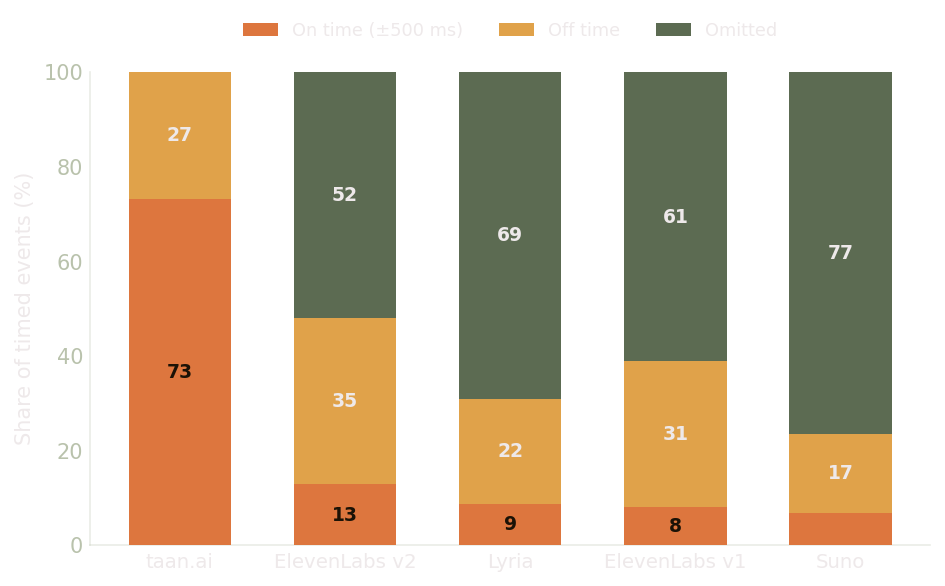
Across four widely used systems, timed events land within ±500 ms only a fraction of the time, and tempo is the only instruction they follow reliably. taan delivers the large majority of instructed events on time, and tops every commercial system on overall instruction success by a wide margin.

SystemInstruction success95% CI Event ±500 msTempo (type 3)
taan.ai80.1%76.3 to 84.073.2%92.0%
ElevenLabs v228.9%25.3 to 32.512.8%87.0%
Google Lyria23.9%20.3 to 27.58.6%89.7%
ElevenLabs v125.4%21.9 to 29.28.0%93.0%
Suno22.0%18.7 to 25.66.8%86.7%

Instruction success = per-clip fraction of instructions delivered (timed events within ±500 ms; tempo within tolerance). Per-instrument timing is measured on separated stems, so every system is passed through the same source separator; because taan is our own system, exact reference stems are available, so its events are scored on the true render rather than on separation error (see the note below).

Overall instruction success rate, taan.ai far ahead of four commercial systems
taan tops overall instruction success. The commercial field clusters low; taan's timing-first architecture clears it by a wide margin.
On-time, off-time and omitted share of timed events by system
taan delivers; the others omit. Commercial systems mostly leave the instructed event out entirely. taan places the large majority on time.
Music quality

Timing first, fidelity right behind it.

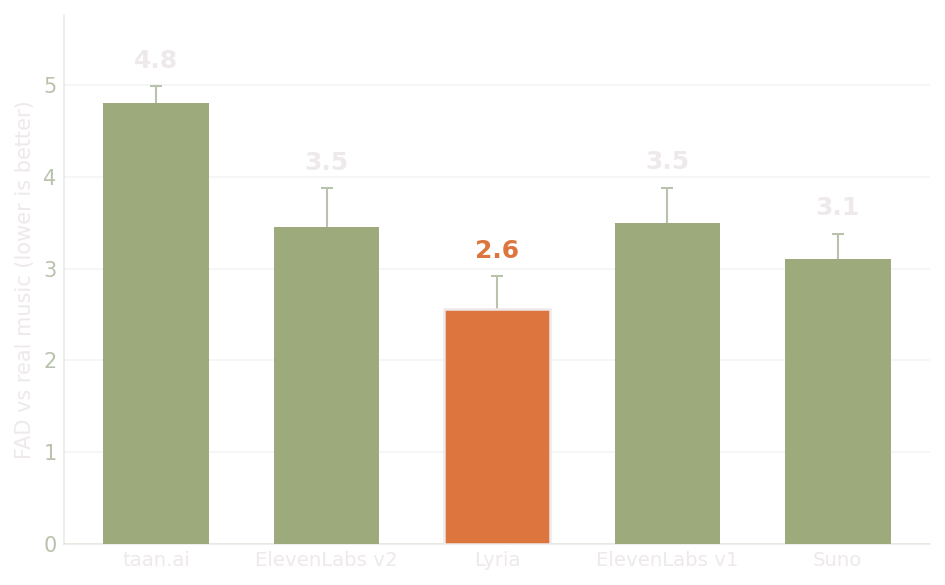
Control only counts if the music still sounds good. Audio fidelity is scored with Fréchet Audio Distance (FAD), a standard generative-audio metric where lower means closer to real music. Each clip is loudness-normalized to −14 LUFS, trimmed to 30 s, and turned into VGGish features, compared against the same fixed real-music reference (GTZAN) for every system including taan. taan is early on fidelity by design, a deliberate trade for the timing precision none of the others have, and fidelity is the fastest-moving part of the stack.

Fréchet Audio Distance by system, lower is better
Fréchet Audio Distance vs real music (lower is better). Lyria is closest to real music at 2.6; the commercial field spans 2.6 to 3.5. taan sits at 4.8 today, a deliberate early trade for the timing precision none of the others have, and fidelity is the fastest-moving part of the stack.
How it is measured

A reproducible, self-calibrated benchmark.

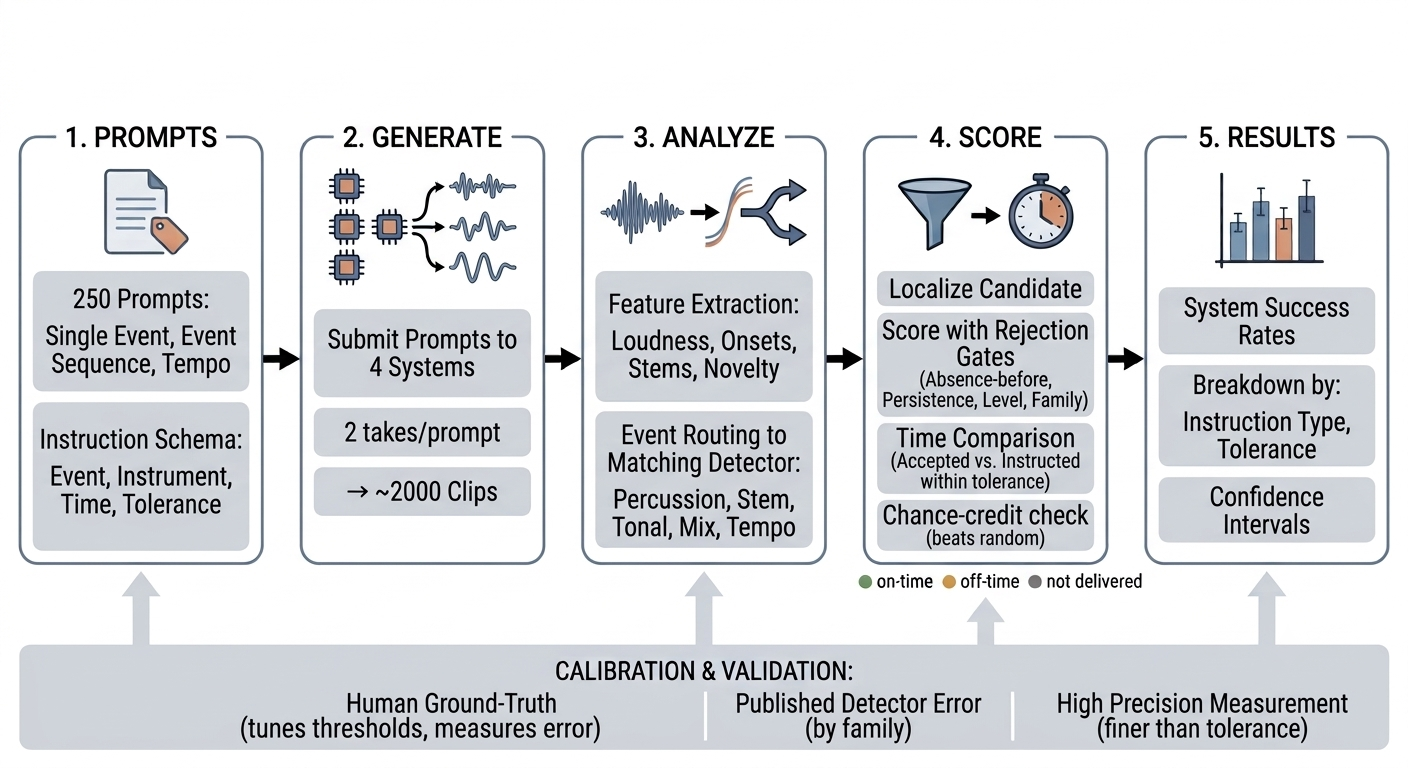
Every score comes from a deterministic signal-processing pipeline: prompts are turned into machine-checkable events, audio is generated, each event is routed to a purpose-built detector, and a candidate is credited only if it clears a cascade of presence checks, so dense arrangements cannot score by luck. The pipeline's own localization error is measured against human labels and published, so model differences are never confused with measurement noise. The same detectors, gates, and tolerances score every system.

Five-stage evaluation pipeline: prompts, generate, analyze, score, results, over a calibration and validation layer
Prompts to generation to analysis to scoring to results, all resting on human calibration and published per-family measurement error. Full methodology is reserved for the paper.
On source separation. Per-instrument timing can be measured after audio is split into stems, so every system has to go through stem separation (htdemucs). The separation is itself a measured source of error. On real-instrument timbres (to which commercial models come very near), the separator is near-transparent (~9 dB on the standard benchmark- musdbhq18, negligible onset error), so the commercial scores are essentially unaffected by it, and hence we use htdemucs for all the commercial systems. On taan's current synthetic timbres it is out-of-distribution for htdemucs or any sota source separation model, hence there is a significant SI-SDR fall following corrupting the onsets of ~27% of the stems by more than 0.5s. Because taan is our own system, exact reference stems are available, so those separation-corrupted events are scored on the exact stems.